
Case study
Boeing. The Future of Air Travel
From speculative research to 7 filed patents with Boeing
Project co-lead
Mixed-methods
Coaching & mentoring
Concept Designer
The challenge
Live Well Collaborative hosts a yearly interdisciplinary studio at the University of Cincinnati, sponsored by Boeing, structured around Research, Ideation, and Refinement phases. As lead of this studio across two cohorts, my goal was to guide interdisciplinary teams of design, architecture, marketing, and engineering students, at both the undergraduate and graduate level, in developing proposals that could meaningfully improve the air travel experience for travelers, airlines, and crew in the year 2040, with the strongest concepts eligible for intellectual property protection.
This is a compiled summary of the process in 2 studio classes. The interdisciplinary teams had students from Design, Architecture, Marketing and Engineering; both at the urdergraduate and graduate level. Additionally the participation of faculty advisors Craig Vogel, Matt Anthony, and Alejandro Lozano-Robledo.
Outcome & impact
Synthesized primary and secondary research into 5 personas representing future air travelers across life stages, giving cross-disciplinary teams a shared, empathetic foundation for ideation.
Built statistical models (OLS regression in R) identifying the strongest demographic and economic predictors of air travel demand, both domestically and globally segmented by country income level.
Led two full cohorts of interdisciplinary student teams through an end-to-end research-to-ideation cycle, translating trend forecasting and user research into concept proposals spanning a range of technology and implementation scope.
7 patents filed from this studio's work, including the Dry Mist Partition and aircraft seating track systems, originated directly from concepts developed under my leadership across these two cohorts.
Presented select concepts, including the fog divider, seat track system, and the quantitative travel-demand analysis, directly to Boeing stakeholders at their offices, translating student research and ideation into proposals reviewed by the sponsoring company itself.
Research Process
01 — Secondary Research
Managed relations with third-party vendor.
02 — Primary Research
13 one-on-one interviews, conducted via video call.
03 — Ideation
Using swim lane process mapping and thematic coding
04 — refinement
Make the next decision easier for everyone.
Process Highlights
Artifact
Futures & secondary research
The team identified significant trends expected to shape air travel by 2040, mapping them using a "futures cone" (inspired by Dunne & Raby's Speculative Everything) to visualize time and uncertainty across possible, plausible, and probable zones. Findings were organized using a STEEP framework (Social, Technological, Environmental, Economic, Political). This trends were also map at their implication level, from individual, plane, airport, city, to systemic level


method
1-on-1 interviews
We conducted semi-structured interviews to characterize future air travelers, building profiles of current retirees and future retirees, teenagers, young professionals, and mid-life adults as they might exist in 2040.
Artifact
Personas
Drawing on the interviews and secondary trend research, the team synthesized the findings into 5 personas representing future air travelers across life stages, as they might exist in 2040. Each persona captured not just demographics but the underlying needs, anxieties, and expectations shaping their travel experience, giving the interdisciplinary team a shared, empathetic foundation to design against rather than ideating for an abstract "average traveler" .

method
Qualitative Analysis
Using R Studio, we built an OLS linear regression model analyzing U.S. domestic air travel departures against social and economic factors, finding population, density, percentage with a bachelor's degree, percentage of older adults (negatively correlated), total GDP, and workforce share in accommodation (NAICS 721) as the strongest predictors. We then extended this globally, building three additional models; after an undifferentiated global model produced weak results, we bucketed countries by income level and found distinct predictors for each: urban population and population share in the largest city for high-income countries; total population for upper-middle-income countries; GDP, population, and income per capita for lower-middle-income countries; and population concentration, density, and education levels for low-income countries.

Ideation Process
01 — by trends
Ideation excersice with combination of trends
02 — by actions
User journey and pain points exploration to ideate solutions
03 — by implementation
Projecting ideas in different levels of implementation, according to technology and scope (personal-communal)
Artifact
Final Design Proposals
The team identified significant trends expected to shape air travel by 2040, mapping them using a "futures cone" (inspired by Dunne & Raby's Speculative Everything) to visualize time and uncertainty across possible, plausible, and probable zones. Findings were organized using a STEEP framework (Social, Technological, Environmental, Economic, Political). This trends were also map at their implication level, from individual, plane, airport, city, to systemic level


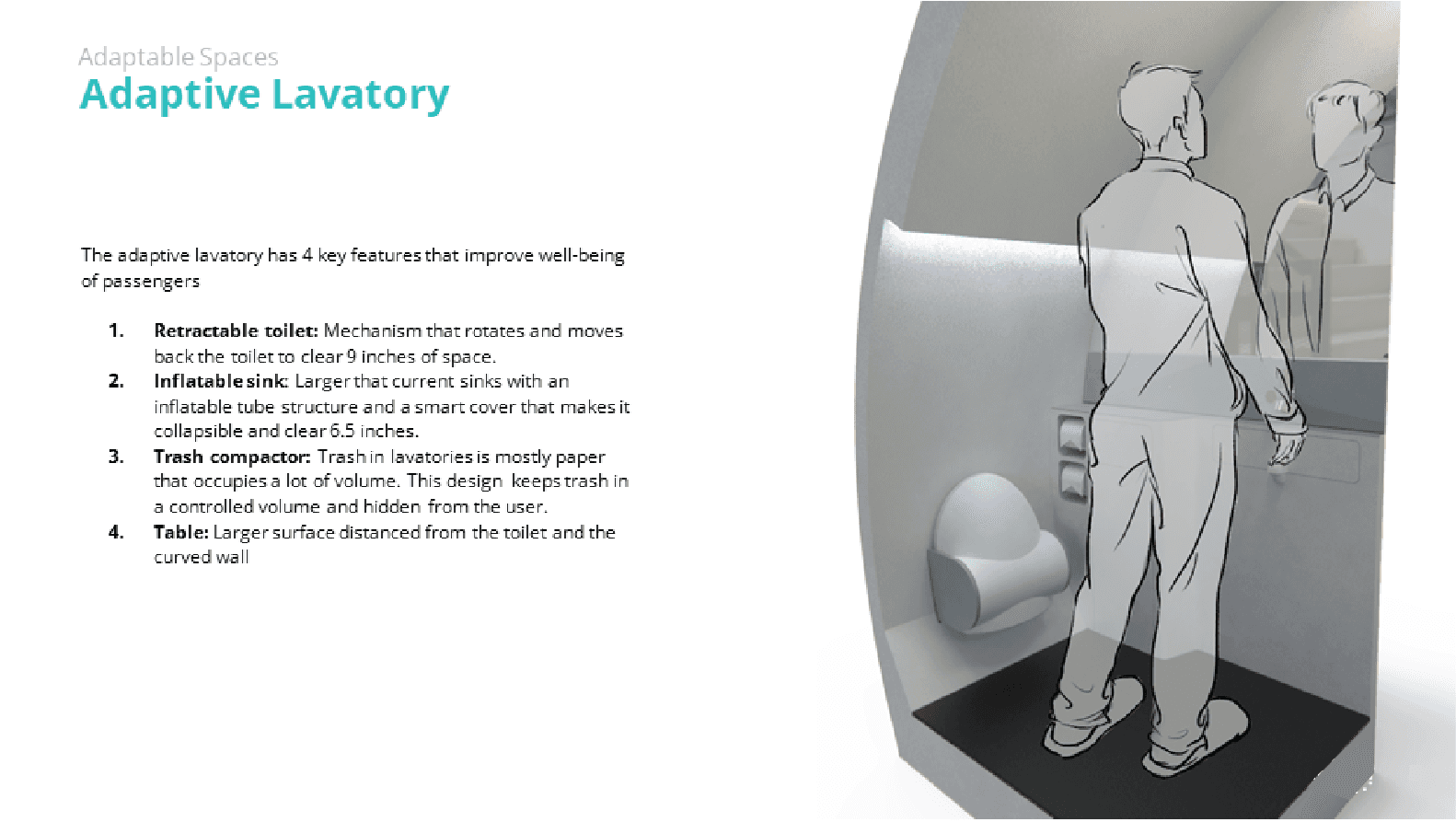


You can see all the patents here: Google Patents by Sebastian Ramirez Loaiza
Reflections and learnings
Stayed open to sense-making around new topics or categories as they emerged, rather than forcing findings into a predetermined framework.
Invited product team members to observe interviews, coaching them beforehand on how to observe, ask follow-up questions, and stay unbiased.
Held a cross-functional debrief after the first interview, which built early alignment across teams involved in the project.